
AI Humanizer for Essays: Create Natural, Human-Like Academic Writing
Introduction
Have you ever spent hours writing an essay only to worry that it sounds too robotic or might get flagged as AI-generated? Many students, writers, and professionals face this challenge, especially when they want their work to sound natural, authentic, and truly their own. That’s why so many people are searching for an AI Humanizer for Essays.
In this guide, you’ll learn how an AI Humanizer for Essays works, why it has become so popular, and how it can help improve the flow and readability of your writing. Whether you're trying to make your content sound more human or simply want better results from AI-assisted writing, this article will give you the insights you need to get started.
What Is an AI Humanizer for Essays?
An AI Humanizer for Essays is a specialized tool designed to make AI-generated content sound more natural and human. Instead of producing text that feels repetitive or overly formal, it improves sentence flow, readability, and overall writing quality. Students, researchers, and professionals often use these tools to create content that connects better with readers.
As Artificial Intelligence (AI) becomes more common in Academic Writing, the demand for content humanization continues to grow. An AI essay humanizer helps bridge the gap between machine-generated text and authentic human communication. The goal isn't to change the message but to present it in a way that feels more natural and engaging.
Definition and Purpose
An essay humanization tool rewrites content to improve tone, clarity, and language fluency. It identifies awkward phrasing, repetitive structures, and unnatural word choices that often appear in AI-generated essays. The result is humanized academic writing that feels smoother and easier to read.
The primary purpose is to help writers maintain content authenticity while improving essay readability. Whether you're writing a research paper, assignment, or personal statement, the tool helps create content that sounds like it was written by a real person rather than a machine.
How AI Humanizers Work
Most AI content humanizer platforms analyze text using Natural Language Processing (NLP) and Machine Learning algorithms. These technologies examine sentence patterns, context, tone, and structure before suggesting improvements.
The system then performs contextual rewriting and sentence restructuring to enhance readability. Instead of replacing words randomly, it focuses on preserving meaning while improving flow. This approach allows users to humanize AI-generated essays without losing important information.
Key Technologies Behind AI Humanization
Modern AI humanizers rely on advanced language models trained on large datasets. These models understand grammar, context, writing style, and semantic relevance. As a result, they can generate more natural writing patterns than traditional content rewriting software.
Natural Language Processing helps the system understand meaning, while Machine Learning continuously improves performance through data analysis. Together, these technologies support intelligent text rewriting that creates human-like essay writing without compromising accuracy.
Why Students and Writers Use AI Humanizers
AI-generated content can save time, but it often requires refinement before submission. Many students use an AI humanizer for student assignments because it improves readability and helps essays sound more authentic. Instead of spending hours editing, they can quickly enhance their work.
Writers also appreciate how these tools support productivity. Whether you're preparing academic essays, blog content, or reports, an AI writing tool for students and professionals can streamline the editing process while maintaining a natural writing style.
Improve Readability
One of the biggest advantages of using an essay improvement tool is better readability. AI-generated content sometimes contains long, repetitive sentences that make reading difficult. Humanization tools simplify these sections and improve overall writing clarity.
A higher readability score often leads to better reader engagement. When content flows naturally, readers can focus on ideas rather than struggling through awkward wording.
Create Natural Writing Flow
Readers expect content to move smoothly from one idea to another. However, AI-generated text may sound mechanical or disconnected. A quality AI essay rewriter improves transitions and creates stronger connections between sentences and paragraphs.
For example, instead of jumping abruptly between concepts, the tool adds logical flow and coherence. This creates a more enjoyable reading experience and improves text coherence throughout the essay.
Save Time on Editing
Manual editing can be time-consuming, especially when working on lengthy assignments. An AI-powered essay editor reduces the workload by identifying areas that need improvement automatically.
Rather than reviewing every sentence repeatedly, writers can focus on refining ideas and arguments. This makes essay writing support faster and more efficient for students with tight deadlines.
Enhance Academic Quality
Strong academic writing requires clarity, structure, and consistency. An AI humanizer that preserves context can help improve these elements while keeping the original meaning intact.
Many academic writing assistant tools also provide grammar correction and writing style enhancement features. These improvements contribute to better academic performance and more polished final submissions.
Benefits of Using an AI Humanizer for Essays
Using an AI Humanizer for Essays offers advantages beyond simple rewriting. It helps transform basic drafts into polished content that feels more engaging, professional, and reader-friendly. This is especially useful when working with AI-assisted essay writing tools that generate first drafts quickly.
The right solution can improve communication while maintaining the writer's intended message. From sentence variety to content optimization, these tools provide practical benefits for students and professionals alike.
More Engaging Content
Readers naturally respond better to content that sounds conversational and authentic. Humanization tools remove robotic phrasing and replace it with language that feels more relatable.
As a result, essays become easier to read and more engaging. This is particularly important when presenting complex ideas that require sustained reader attention.
Better Sentence Variety
One common issue with AI-generated content is repetitive sentence structure. A human-like essay writing tool introduces variation by restructuring sentences and adjusting wording.
This variety creates a more dynamic reading experience. It also helps prevent content from feeling predictable or monotonous.
Improved Clarity and Structure
Clear organization makes essays easier to understand. AI content refinement tools help improve logical flow, paragraph transitions, and sentence structure.
When ideas are presented clearly, readers can absorb information more effectively. Better structure also strengthens the overall quality of academic content.
Consistent Writing Style
Maintaining consistency across a long essay can be challenging. Humanization tools help ensure that tone, vocabulary, and style remain uniform throughout the document.
This consistency contributes to a more professional appearance and supports content optimization goals without making the writing feel artificial.
Enhanced User Experience
A well-written essay creates a positive experience for readers. Smooth transitions, clear language, and natural flow all contribute to stronger engagement.
Whether you're using a free AI humanizer for essays or a premium platform, improving user experience can make your writing more impactful and memorable.
Key Features to Look for in an AI Humanizer for Essays
Not all humanization tools deliver the same results. Some focus only on replacing words, while others use advanced Natural Language Processing to improve flow, clarity, and context. Choosing the right tool can make a significant difference in the quality of your final essay.
When evaluating an AI Humanizer for Essays, look for features that support accuracy, readability, and content authenticity. The best platforms combine intelligent rewriting with practical editing tools to help you produce polished academic work.
Context-Aware Rewriting
Context-aware rewriting is one of the most important features in any AI essay humanizer. Instead of changing words without understanding meaning, the tool analyzes the surrounding content to ensure that revisions fit naturally within the text.
This approach helps preserve the original message while improving readability. If you're looking for an AI essay humanizer without changing meaning, context awareness is essential because it prevents awkward rewrites and maintains semantic relevance.
Grammar and Style Enhancement
Even strong essays can suffer from grammar mistakes or inconsistent writing styles. A reliable AI-powered essay editor should include grammar correction and writing style enhancement capabilities that improve overall quality.
These features help eliminate errors, strengthen sentence structure, and improve language fluency. As a result, your writing appears more polished and professional without requiring extensive manual editing.
Tone Customization
Different academic assignments require different writing styles. A persuasive essay, for example, may need a more confident tone than a reflective paper. Tone customization allows users to adjust content according to their specific goals.
This flexibility supports content personalization and helps writers maintain a natural writing style. Whether you're preparing a formal report or a personal essay, tone adjustments can improve how your message is received.
Plagiarism-Free Output
Originality remains a key concern in Academic Writing. Humanization tools should enhance content while ensuring that the final output remains unique and plagiarism-free.
Many modern platforms include content authenticity checks that help writers create original work. Combined with responsible use, these features support academic integrity while improving readability and structure.
Multi-Language Support
Students and professionals around the world use AI writing tools. Multi-language support makes it possible to humanize content in different languages while maintaining accuracy and context.
This feature is especially valuable for international students and multilingual writers. It expands accessibility and allows more users to benefit from advanced educational technology.
How to Use an AI Humanizer for Essays Effectively
Using an AI humanizer correctly can greatly improve your results. Simply pasting text into a tool isn't enough. To achieve high-quality output, you should combine AI assistance with thoughtful review and editing.
The most effective workflow involves drafting, refining, reviewing, and proofreading. Following these steps helps ensure that your essay remains accurate, natural, and academically appropriate.
Generate an Initial Draft
Start by creating a draft using your preferred writing method. Some writers begin from scratch, while others use AI-assisted essay writing tools to generate a foundation for their content.
At this stage, focus on organizing ideas and covering the main topic. Don't worry too much about perfect wording because the humanization process will help refine the text later.
Humanize the Content
Once your draft is complete, submit it to an AI Humanizer for Essays. The tool will analyze the content and apply improvements designed to create a more human-like writing style.
This process may include sentence restructuring, vocabulary adjustments, and contextual rewriting. The goal is to convert AI text into human writing that feels natural and engaging.
Review and Edit the Output
Although AI tools can produce impressive results, they shouldn't replace human judgment. Carefully review the rewritten content to ensure that it accurately reflects your intended meaning.
Look for areas where additional improvements may be needed. Small edits can strengthen clarity and make the content feel more personal and authentic.
Verify Accuracy and Citations
Humanization tools improve language, but they don't automatically verify facts. Always check statistics, references, and citations before submitting an academic essay.
This step is particularly important when using AI-assisted content. Accurate information supports credibility and helps maintain academic standards.
Final Proofreading
Before submitting your essay, perform a final proofreading session. Read the content aloud if possible. This simple technique often reveals awkward phrasing that might otherwise go unnoticed.
Final proofreading also helps catch grammar issues, formatting inconsistencies, and missing details. A few extra minutes of review can significantly improve the finished product.
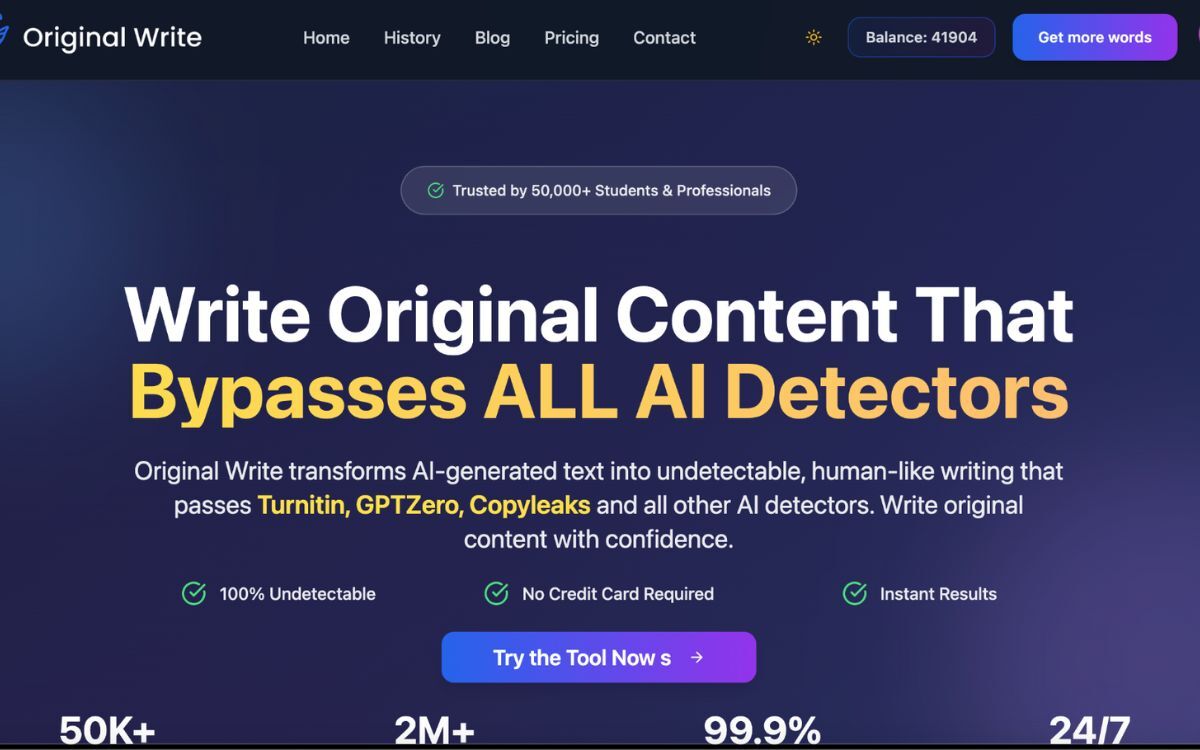
Why Choose Original Write for Essay Humanization?
Students and professionals need more than simple text rewriting. They need a solution that understands context, preserves meaning, and improves overall quality. Original Write focuses on delivering humanized academic writing that feels authentic while maintaining the writer's original intent.
The platform combines advanced language models, content optimization techniques, and intelligent editing features to create natural results. Whether you're searching for the best AI humanizer for essays or simply want to improve essay readability with AI, Original Write offers practical tools designed for modern academic needs.
Original Write also emphasizes content authenticity and readability. Instead of making unnecessary changes, it refines structure, strengthens flow, and enhances clarity. This balanced approach helps users create essays that are both engaging and academically appropriate.
Another advantage is efficiency. Writers can save time during editing while still maintaining control over the final output. For students managing multiple assignments, this combination of quality and convenience can be a valuable asset.
AI Humanizer for Essays vs Traditional Editing
Both AI humanizers and traditional editing aim to improve writing quality, but they approach the task differently. Understanding these differences can help you choose the right solution for your needs.
Traditional editing relies entirely on human expertise. While highly effective, it can require significant time and effort. Human editors carefully review structure, tone, and grammar, often providing detailed feedback that helps writers improve their skills.
An AI Humanizer for Essays, on the other hand, offers speed and scalability. It can analyze large amounts of text within seconds and suggest improvements instantly. This makes it particularly useful for students working under tight deadlines.
The best approach often combines both methods. An AI content humanizer can handle initial refinement, while human review ensures accuracy, context, and personal voice. Together, they create a balanced editing process that maximizes quality and efficiency.
| Feature | AI Humanizer | Traditional Editing |
|---|---|---|
| Speed | Very Fast | Slower |
| Cost | Often Lower | Usually Higher |
| Consistency | High | Depends on Editor |
| Context Understanding | Improving Rapidly | Strong |
| Personal Feedback | Limited | Extensive |
| Scalability | Excellent | Limited |
Rather than viewing these options as competitors, many writers use them together. AI handles repetitive editing tasks, while human expertise provides the final layer of refinement and quality control.
Common Mistakes to Avoid
While AI humanization tools can significantly improve writing quality, they are not perfect. Many users assume that a single click will produce a flawless essay. In reality, achieving the best results requires careful review and thoughtful editing.
Understanding common mistakes can help you get more value from your chosen tool. By avoiding these pitfalls, you'll create stronger essays that remain accurate, authentic, and engaging.
Over-Reliance on AI Tools
One of the most common mistakes is depending entirely on AI-generated output. Even the most advanced AI humanizer for college essays can miss subtle details that a human writer would notice.
Think of AI as a writing assistant rather than a replacement for critical thinking. Your knowledge, creativity, and judgment still play an important role in producing high-quality academic work.
Skipping Fact-Checking
Humanization tools focus on improving language and readability, not verifying information. If your essay contains incorrect facts, statistics, or references, those errors may remain unchanged after rewriting.
Always review sources and confirm the accuracy of any claims. Fact-checking protects your credibility and supports academic integrity.
Ignoring Personal Voice
An essay should still sound like you. Some writers accept every AI suggestion without considering whether it reflects their own style and perspective.
Adding your personal voice helps create content authenticity and makes your writing more memorable. Readers often connect better with essays that feel genuine rather than generic.
Not Reviewing the Final Output
Submitting content without reviewing the final version is another common mistake. While AI tools can improve grammar and flow, occasional issues may still appear.
Take time to read the completed essay carefully. A final review helps ensure clarity, consistency, and overall quality before submission.
Best Practices for Humanizing Essays
Successful essay humanization involves more than simply rewriting text. The best results come from combining AI capabilities with strong writing habits and careful editing.
Following a few proven practices can help you create content that sounds natural while maintaining academic standards and originality.
Maintain Original Meaning
The purpose of humanization is to improve readability, not change your ideas. Always verify that the revised content communicates the same message as the original draft.
A quality AI humanizer that preserves context should retain your core arguments while improving sentence flow and language fluency.
Use Natural Transitions
Strong transitions guide readers smoothly from one idea to the next. Without them, even well-written essays can feel disjointed.
Words and phrases such as "however," "for example," "meanwhile," and "as a result" help create better connections between concepts. This improves text coherence and overall readability.
Add Personal Insights
AI can organize information effectively, but it cannot fully replicate personal experiences or unique perspectives. Adding your own observations makes essays more authentic and engaging.
For example, a brief example from your studies or personal experience can strengthen an argument and create a stronger connection with readers.
Keep Academic Standards Intact
Humanization should never come at the expense of academic quality. Maintain proper citations, clear arguments, and professional language throughout your work.
Even when using tools to make AI essays sound human, you should continue following the requirements of your institution or instructor.
Future of AI Humanizers in Academic Writing
The future of essay humanization looks promising. Advances in Artificial Intelligence (AI), Natural Language Processing, and Machine Learning continue to improve how writing tools understand and refine content.
As these technologies evolve, writers can expect more accurate suggestions, stronger contextual understanding, and increasingly natural output. The gap between machine-generated text and human communication will likely continue to shrink.
Advanced NLP Improvements
Natural Language Processing has already transformed content humanization. Future developments will allow AI systems to better understand tone, intent, and audience expectations.
These improvements will lead to more sophisticated contextual rewriting and writing style enhancement. As a result, essays will require less manual editing while maintaining high quality.
Personalized Writing Assistance
Future educational technology will likely offer more personalized experiences. Instead of applying generic edits, AI systems will adapt to individual writing preferences and goals.
This level of content personalization could help students maintain a consistent voice while improving clarity, structure, and readability.
Smarter Context Understanding
Current tools are becoming increasingly effective at understanding context, but future systems will go even further. Improved machine learning writing tools will recognize subtle nuances, subject-specific terminology, and complex academic concepts.
This smarter context understanding will make it easier to humanize academic essays online while preserving accuracy and meaning. Writers will benefit from more precise recommendations and higher-quality output.
FAQs
What is an AI humanizer for essays?
An AI humanizer for essays is a tool that rewrites AI-generated content to make it sound more natural, readable, and human while preserving the original meaning.
How does an AI essay humanizer work?
It uses Natural Language Processing (NLP) and Machine Learning to analyze text, improve sentence structure, enhance tone, and create smoother writing flow.
Can AI humanizers improve essay quality?
Yes. They can improve essay readability, clarity, sentence variety, and overall structure, making content more engaging and easier to understand.
Are AI-humanized essays plagiarism-free?
Most humanization tools aim to create unique content, but writers should still check originality and verify sources before submission.
Why should I use an AI humanizer for essays?
An AI Humanizer for Essays can save editing time, improve writing quality, enhance readability, and help create more authentic academic content.
Conclusion
AI writing technology has changed how students and professionals approach Essay Writing. While AI-generated drafts can save time, they often need refinement to achieve the clarity, flow, and authenticity that readers expect. That's where an AI Humanizer for Essays becomes a valuable tool. By improving readability, enhancing structure, and creating a more natural writing style, these solutions help transform rough drafts into polished academic content.
The most effective approach combines technology with human judgment. Use AI to streamline editing and improve efficiency, but always review the final output carefully. When used responsibly, an AI Humanizer for Essays can support academic success, strengthen communication, and help you create content that feels genuinely human while maintaining high academic standards.